

Teleology Is Everything
What Happens When a World Becomes a Theory
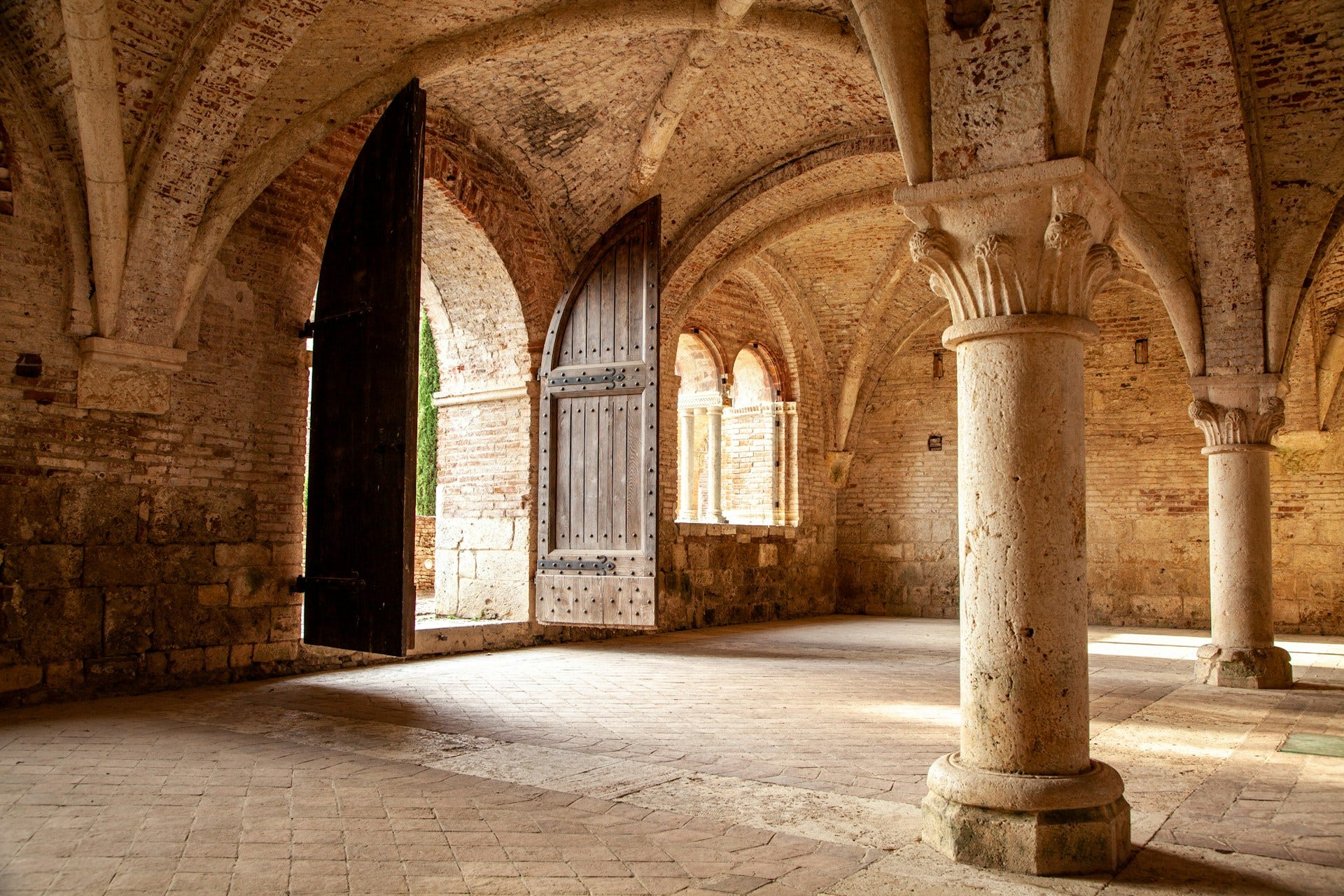
There is a peculiar vertigo that sets in after prolonged immersion in the classical tradition. You read the canonical texts. The ancient frameworks begin to feel truer than the assumptions of the present age. Your way of life shifts accordingly. The desire for what they describe is sincere.
Yet a nagging unreality remains.
What confronts you in the books are not merely ideas but fragments of a world lost. Telos was not once a position to be defended or a concept to be recovered. It was the atmosphere people breathed. It furnished the horizon of meaning within which action, virtue, and purpose became intelligible.
Today that horizon has receded. The concepts survive, but the world that rendered them ordinary has disappeared. What was once embedded in a form of life now confronts us as an intellectual artifact.
That gap (between the metaphysical vision and the formative world that once sustained each other) is what this essay is about. To understand why the gap exists, you have to understand what was lost. That requires resisting the temptation to romanticize it.
The difference between the pre-modern world and ours is not moral quality. People in the ancient and medieval world were violent, confused, vicious, and petty in ways we recognize immediately. They were not psychologically serene or metaphysically transparent. The difference was not in how well they lived but in what living was taken to be. A craftsman’s knife is for cutting—that’s not a value judgment someone imposes on the knife, it’s what the knife is. The pre-modern framework applied that same logic to living things, including human beings. You had a nature. Your nature had a direction. The moral life was the project of actually becoming what you already were in potential.
This means telos (the Greek word for end, or purpose) wasn’t an ethical supplement you added after reflection. A human being arrived into an order that preceded them, purpose part of what you were rather than something acquired. The question your life posed was not “what do I want to become?” but “what am I, and what does that demand of me?”
Crucially, this wasn’t primarily a theory people held. It was the habitat they lived in. The metaphysical conviction and the social world that expressed it (the rituals, the disciplines, the institutions, the expectations of a community) reinforced each other so thoroughly that neither required conscious maintenance. You didn’t choose to inhabit a teleological world any more than you choose to breathe the air.
Modern people tend to translate this into psychological terms: people used to care more about purpose, or think more seriously about meaning. That’s not the claim. The ordering was taken to be a feature of reality, not a psychological orientation or cultural preference, but something ontological.1 Which raises the question of how the grammar was lost—and why that loss is not simply one cultural shift among others, but the shift that makes all the subsequent ones intelligible.2
It didn’t collapse suddenly. It eroded through several developments (intellectual, political, institutional, and technological) that reinforced one another. What follows traces one particularly important strand of that larger story.
In the 14th century, William of Ockham and the nominalist tradition he represented were responding to a problem inside the tradition itself. High scholasticism (the great synthetic project of the 12th and 13th centuries, culminating in Aquinas) had rationalized the faith to a remarkable degree. The architecture was extraordinary: reason and revelation held in harmonious integration, the structure of reality rendered philosophically legible, all the way down to God’s existence demonstrable through argument. But that ambition carried a cost. A God whose rationality was fully integrated into a philosophical system began to look like a God whose will was bound by that system—constrained and domesticated by Greek categories. Ockham’s nominalism was a theological protest against that overreach. To protect God’s absolute freedom, he insisted that universals aren’t real features of the world. “Human nature” doesn’t name an actual structure that individual humans participate in. It’s a mental label applied to a collection of similar individuals. Reality is just particulars. Duns Scotus had already moved in this direction before him, locating goodness in God’s will rather than in the nature of things.
The irony is that the attempt to free God from rationalist constraint ended up severing the participatory link between creation and its source. If universals aren’t real, human nature isn’t real in the relevant sense—and if human nature isn’t real, there is no natural end, no telos built into what a human being is. The entire architecture of classical ethics quietly lost its foundation.
By the time René Descartes wrote his Meditations in 1641, the crisis this set in motion had become acute (Descartes was among the decisive figures in what followed, though not the only one). The Reformation had shattered the shared institutional framework for theological authority. The Wars of Religion had demonstrated what happens when that framework collapses. Descartes was looking for a foundation that could survive the wreckage. He found it inside the isolated thinking subject. Cogito ergo sum. Everything else must be reconstructed from there.
That reconstruction helped reshape the trajectory of what followed. The knower was no longer a participant in a larger rational order, embedded in a world that preceded and exceeded the self, but a self-enclosed mind trying to reach outward to an external world it couldn’t directly access. Certainty relocated from participation in being to the interior of the subject. Once that move was made, telos followed: purpose was no longer something a human being discovered by apprehending their own nature. It became something the self constructed and revised. The self became prior to its ends.
One of the most consequential developments downstream of that relocation was the transformation of how purpose itself was understood. One temptation is to think that what follows is simply the absence of metaphysics—a neutral, secular clearing where questions of human nature are set aside. But metaphysics doesn’t disappear when telos does. It relocates onto whatever the new framework takes as foundational, and operates there without examination, which is precisely what makes it so difficult to argue with.
The autonomous individual, their preferences, the biological substrate, the social contract aren’t metaphysics-free positions. They are positions with unexamined metaphysics, carrying the full weight of what telos used to carry, but without the visibility. The modern person doesn’t think, “I believe the autonomous individual is the foundational metaphysical reality.” They just find that conclusion obvious, and the alternative faintly absurd. That’s what unexamined metaphysics feels like from the inside: not a position you hold, but the ground you stand on without noticing.
The consequences show up most clearly in what happens to formative structures once the metaphysical horizon shifts. Without a shared account of what human beings are for, the structures that once expressed and reinforced that account become available for reinterpretation. They’re not necessarily rejected but are reinterpreted through the logic of choice.
The Orthodox convert is perhaps the clearest case. Something in the tradition has genuinely answered a real hunger. The commitment is real and the practices are undertaken seriously. Yet the tradition arrives as one option amongst alternatives, chosen rather than inherited, inhabited alongside the awareness that other people have chosen differently and that the choice remains, at least in principle, reversible. The metaphysical structure of Orthodoxy (theosis, participation, the transformation of the person by something genuinely other than the self) is affirmed intellectually while the surrounding culture continuously frames it as a lifestyle rather than a given.
Harder to fault is the traditionalist who experiences liturgy primarily as beauty. The liturgy is genuinely beautiful, and responding to it is not nothing. But liturgy was not primarily designed to be witnessed. It was designed to form, to reorganize perception, desire, and habituated response over years and decades, through embodied repetition within a community that shared the same metaphysical assumptions. Received as an aesthetic experience, it remains moving but it does not necessarily form. The difference is not in the sincerity of the response but in what the response is a response to.
Most self-implicating of all is the person who has recovered the theory. They have read MacIntyre and understood the diagnosis with genuine care. The teleological framework is not merely academically interesting to them. It has reorganized how they think about virtue, about their own character and that of others, and about what a human life is for. They hold these commitments as convictions, not positions. And yet their daily life, its rhythms, pressures, the ambient expectations of colleagues and institutions and the market, is organized around entirely different assumptions. They think teleologically for an hour in the morning and spend the rest of the day inside a world that doesn’t. Telos is a view they return to rather than a world they inhabit. The recovery attempt and the gap it cannot close are equally real.
None of these are cynics or hypocrites. They encountered something true and reached toward it. The problem is that the metaphysical and formative worlds that once reinforced each other have come apart, and the grammar of the world they actually live in continuously reinterprets what they are trying to do.
The same logic works in the other direction. Without formative structures, metaphysical commitments become increasingly abstract, held as positions rather than inhabited as realities. The contemporary traditionalist can recover a cohesive teleological metaphysics, but does so as an individual choosing amongst many competing options like a consumer selecting cereal in the grocery store. They can recover fragments of teleological formation, but those fragments exist within a social order organized around fundamentally different assumptions.
What’s true of individual moral vocabulary reflects this same coming-apart. A person practicing courage in the classical sense was actualizing something real about what a human being is, within a world that recognized and sustained that actualization. A person managing risk tolerance is executing a strategy in service of ends they’ve already chosen, within a world that has no common account of what courage is for. The word survives. What it was pointing at doesn’t. The same substitution runs through much of our inherited moral vocabulary. The language remains; the world that made the language intelligible does not.
What’s true of individual moral vocabulary is true at the civilizational level. The centuries immediately following the Cartesian shift3 produced genuine achievements including the scientific revolution, the liberal political order, the great literary and artistic traditions of modernity. These weren’t illusions but they were drawing on a reservoir of meaning, moral seriousness, and institutional coherence that the new framework had no mechanism to replenish. That reservoir has been draining for four hundred years. We are the first generations to find it visibly low.
What’s worth understanding is how long serious people have been pressing against the problem, and what they were able and unable to accomplish.
Johann Georg Hamann was objecting in the 18th century, while Kant was still alive. Where the Enlightenment imagined reason operating independently of language, history, and embodiment, Hamann insisted this was an illusion. Reason is always someone’s reason. It cannot step outside the life that does the reasoning.
John Henry Newman pressed even closer to this essay’s central concern. Against the assumption that truth is primarily a matter of propositions and arguments, he argued that knowing requires a formed knower. His concept of the illative sense described the way real assent depends on accumulated experience, habituated judgment, and cultivated perception. A person trained differently will arrive at different conclusions from the same evidence.
Maurice Blondel attacked the problem from another direction. The sovereign self, he argued, cannot satisfy itself from its own resources. Human desire continually exceeds every finite object it attains, pointing beyond itself toward something it cannot generate.
The twentieth century multiplied these critiques. Heidegger challenged the idea of the isolated subject altogether. Gilson and de Lubac attempted to recover elements of the participatory metaphysics that late modernity had abandoned. MacIntyre traced the fragmentation of moral discourse after the loss of teleology, while Taylor demonstrated that the modern self was historically constructed rather than inevitable.
All of this work is serious; some is indispensable. None of it has restored the conditions it diagnoses. The limit isn’t the quality of the thinkers. What none of them could do (what no thinker can do) is reconstruct a world through description. The habitat cannot be rebuilt from the theory alone, any more than you can restore an ecosystem by writing an accurate account of what it used to contain.
That’s the tragedy.
Which brings us back to the unsettling fact that understanding a tradition is not the same thing as inhabiting it.
Consider what serious engagement with this tradition actually looks like in practice. The texts get read; the framework proves compelling; practices are adopted, commitments made, a tradition joined. The desire is genuine. Underneath all of it, the metaphysical commitments and the formative structures that were once mutually reinforcing now require constant individual effort to hold together because the broader social world in which they once cohered naturally is organized around different presuppositions. Even the person who recognizes the sovereign self’s operation and genuinely tries to submit faces the same structural problem: the monastery exists within a world that does not share its metaphysics, and that world continuously reinterprets what happens inside it.
At some point the honest modern person will ask whether the texts themselves are even useful. If the world that produced them is gone, what exactly are we doing when we read Aristotle, Augustine, the Philokalia, St. Benedict, or Aquinas? The question is fair. Historically, these texts were formative instruments inside living traditions. They were carried by communities and embodied in practices that shared a common horizon of meaning. That wider world gave them their full weight. Detached from those worlds, they cannot function as self-sufficient vehicles for what they describe. What they can do is show what the convergence looked like from the inside, which is not nothing. A person who reads them seriously knows precisely what is missing. Someone who hasn’t doesn’t. That knowledge is not the thing itself but it is a more accurate map of the territory.
The obvious objection deserves a direct answer: formation does happen through institutions, liturgy, family, discipline, and community. This essay isn’t denying that. People are genuinely shaped by what they didn’t choose. The practices handed to them, the traditions they were born into, the communities that made demands before they could negotiate are real mechanisms and they do real work. The question is whether those containers are intact enough, and coherent enough with one another, to do the work they once did. And whether the world in which they exist sustains or continuously erodes what happens inside them.
This is where people actually live—not choosing between medieval Christendom and liberal modernity, but amongst fragments. A person formed by serious engagement with even partial remnants of a teleological tradition is different from someone who has encountered none of it. But what the fragments cannot do, on their own, is reconstitute the convergence that gave them their full force. The fragment of liturgy exists within a week whose every other hour is organized around different ends. The practice of fasting exists within a culture of engineered abundance, where the entire food environment is designed to make fasting feel aberrant. The practice of silence exists within an attention economy engineered to prevent it. The text is read by a self that, returning from the page, re-enters a world running a different formation program at every level. None of that makes the fragments worthless. It makes them worth understanding precisely, which is different from either dismissing them or mistaking them for the whole.
The argument here proceeds on a claim it doesn’t pause to defend: that human beings have a nature with a direction, and that losing this as a shared assumption constitutes genuine metaphysical impoverishment rather than mere cultural change. Readers who want to pursue the underlying case might start with Alasdair MacIntyre’s “Dependent Rational Animals”, Étienne Gilson’s “Being and Some Philosophers”, or David Bentley Hart’s “The Experience of God”.
The genealogy sketched here is not intended as a monocausal explanation of modernity. It isolates one strand of a much larger historical transformation. The erosion of teleological consciousness involved theological, political, economic, technological, and philosophical developments that cannot be separated from one another. The sequence as described is best understood as a lens rather than a complete account.
The Cartesian shift refers to the philosophical reorientation associated with René Descartes’ “Meditations on First Philosophy” (1641), in which the ground of certainty moves from participation in a shared rational order to the interior experience of the thinking subject. The cogito—“I think, therefore I am”—establishes the isolated self as the foundation from which all knowledge must be reconstructed. The shift is named for Descartes but was prepared by the nominalist tradition of the 14th and 15th centuries and consolidated by subsequent thinkers including Locke, Hume, and Kant. Its significance for this essay is anthropological: once the self is installed as the primary epistemic foundation, teleology ceases to appear as an immediately given feature of reality and increasingly requires justification from the standpoint of the subject.